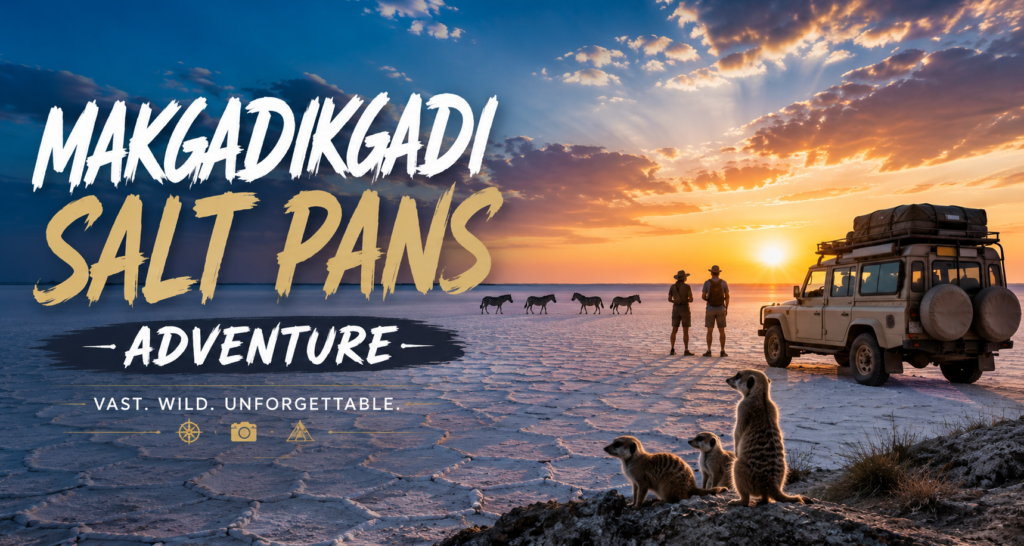
Imagine standing in the middle of a blinding white expanse where the earth meets the sky in a perfect, uninterrupted line. There are no trees, no buildings, and no sounds. The silence is so absolute that you can hear the blood pumping in your ears. This is not another planet—it is the Makgadikgadi Salt Pans in Botswana, one of the most surreal and captivating landscapes on Earth.
Whether you want to sleep under a canopy of billions of stars, hang out with wild meerkats, or speed across empty desert flats on a quad bike, a Makgadikgadi adventure is a journey you will never forget.
In this guide, we answer the most popular questions travelers search on Google to help you plan the ultimate trip to this magical corner of Africa.
What is the Makgadikgadi Salt Pans adventure?
The Makgadikgadi Salt Pans adventure is a unique safari experience in northeastern Botswana. Unlike traditional safaris focused solely on tracking the “Big Five” from a vehicle, an adventure here is about experiencing sublime isolation, ancient landscapes, and unique desert-adapted wildlife. It combines thrilling outdoor activities like quad biking and wild camping with deeply touching cultural encounters and up-close wildlife interactions. It is a journey of self-discovery where the sheer scale of the landscape leaves you feeling wonderfully small.
Where are the Makgadikgadi Salt Pans located?
The Makgadikgadi Pans are located in the dry savanna of northeastern Botswana, south of the Okavango Delta and surrounded by the Kalahari Desert. The complex covers over 16,000 square kilometers (about 6,200 square miles), making it one of the largest salt flat systems in the world.
The area is divided into several massive basins. The largest is Ntwetwe Pan in the west, followed by Sua (Sowa) Pan in the east, and Nxai Pan to the north. The gateway towns to this region are Nata and Gweta, which sit along the main road between Maun and Francistown.
How were the Makgadikgadi Salt Pans formed?
Thousands of years ago, this entire area was covered by Lake Makgadikgadi—an ancient superlake that once spanned an area larger than Switzerland. Over millennia, tectonic shifts blocked the rivers that fed the lake, causing it to slowly dry up.
As the water evaporated under the blazing African sun, it left behind thick layers of salt and clay. Today, those remnants form the vast, cracked, glittering crusts that we see today.
What is the best time to visit Makgadikgadi Salt Pans?
The best time to visit depends entirely on what kind of adventure you are looking for. The region has two distinct seasons, each offering a completely different experience:
The Dry Season (June to October): This is the best time for classic desert adventures. The salt flats are bone-dry, hard, and safe to drive on. This is when you can go quad biking, sleep out in the open under the stars, and enjoy clear, cloudless nights. The temperatures are warm during the day but can plunge close to freezing at night.
The Wet Season (November to March/April): When the rains arrive, the pans undergo a magical transformation. The dry clay crust fills with water, turning the flats into shallow, mirror-like lakes. While the pans themselves become inaccessible to vehicles, the surrounding grasslands turn lush and green, drawing in thousands of migratory animals and birds.
What wildlife can you see in the Makgadikgadi Pans?
Despite the harsh, arid environment, the Makgadikgadi region is teeming with life.
During the dry season, you will spot desert-adapted specialists. These include the rare brown hyena, aardwolves, bat-eared foxes, gemsbok (oryx), and springbok.
During the wet season, the area becomes the stage for Africa’s second-largest mammal migration. Over 20,000 zebras and wildebeests migrate from the Boteti River to graze on the nutrient-rich grasses of the pans, closely followed by predators like lions, cheetahs, and leopards.
Additionally, the flooded pans attract hundreds of thousands of greater and lesser flamingos, turning the blue waters into a breathtaking sea of bright pink.
Can you see meerkats in the Makgadikgadi Salt Pans?
Yes! In fact, meeting the habituated meerkats of Makgadikgadi is one of the most famous highlights of the trip.
Several families of meerkats living near the edge of the Ntwetwe Pan have been studied and followed by researchers and guides for years. Because of this, they are completely relaxed around humans. They do not view us as predators.
Instead, if you sit quietly on the ground in the early morning, these curious little creatures might use your head or shoulder as a high-up lookout tower to scan the horizon for jackals and birds of prey. It is an incredibly intimate, heartwarming wildlife encounter.
What is it like to sleep out under the stars in the salt pans?
Sleeping out in the middle of the salt pans is a bucket-list experience. Because there is absolutely no light pollution for hundreds of miles, the night sky comes alive in a way you have never seen before. The Milky Way arches across the sky like a bright, glowing highway.
Many tour operators set up “fly camps” directly on the salt crust. You sleep on a comfortable bedroll on the ground with nothing but the sky above you. Because the ground is so dry and salty, there are no plants, no wild animals, and absolutely no mosquitoes out on the pans during the dry season—meaning you can sleep in peace without a tent or mosquito net.
What is Kubu Island and why is it famous?
Kubu Island (also known as Lekhubu Island) is a ghostly, dry granite rock island that rises out of the flat, white salt of Sua Pan.
It is famous for its hauntingly beautiful, ancient baobab trees that grip the rocks with thick, twisted trunks. The island holds deep spiritual significance for the local San (Bushmen) people, who have used it for sacred ceremonies for generations.
Walking among these giant, centuries-old trees at sunrise or sunset feels like stepping back in time to an ancient, forgotten world.
Is quad biking allowed on the Makgadikgadi Salt Pans?
Yes, quad biking is one of the most thrilling activities you can do here, but it is strictly regulated to protect the fragile environment.
During the dry season, guided tours allow you to ride lightweight quad bikes across the endless white plains. Because there are no obstacles, roads, or signs, you get a wild sense of freedom as you speed over the hard, flat crust.
Pro Tip: Pack your camera safely away in a dust-proof bag while riding, wear goggles or wraparound sunglasses, and try to ride near the front of the group to avoid inhaling the fine white dust kicked up by other bikes!
How do you get to the Makgadikgadi Salt Pans?
Most travelers fly into Maun (the tourism hub of Botswana) or Kasane. From Maun, you can rent a heavy-duty 4×4 vehicle and drive east toward Gweta or Nata. The drive takes about 2 to 3 hours on tarred roads before you head off-road into the wilderness.
Because navigating the trackless salt pans can be incredibly confusing and dangerous (it is easy to get lost or get stuck in hidden wet patches beneath the dry crust), it is highly recommended to visit with an experienced local guide or book a package with a specialized safari lodge.
Do I need a visa to visit Botswana for a Makgadikgadi safari?
Most international travelers require a visa to enter Botswana, though citizens of some countries are exempt for short tourist stays.
Because immigration rules can change, it is vital to check your country’s specific visa requirements well before your travel date. To avoid long lines at the embassy or the stress of last-minute paperwork, applying for a tourist eVisa online is the fastest and most convenient route.
How can I apply for a Botswana tourist eVisa easily?
Planning an African safari should be exciting, not stressful. You can easily apply for your official Botswana Tourist eVisa online through a simplified and secure process.
Instead of dealing with complicated government portals or confusing paperwork, our streamlined platform allows you to submit your application in just a few minutes. All you need to do is fill out a simple form, upload your travel details, and let our team handle the rest.
Why choose us for your Botswana eVisa?
When planning an expedition to a remote destination like the Makgadikgadi Salt Pans, you want to make sure every travel detail is perfect. Here is why travelers trust us to handle their visa process:
Reliable Travel Visa Services: Our global approach has successfully assisted numerous travelers from all over the world in obtaining their official visas without any hassle.
Round-the-Clock Assistance: Travel planning doesn’t keep office hours. You can reach out to us 24/7, and our dedicated visa experts will respond to your queries within 72 hours.
Experienced Visa Consultants: We review your documents thoroughly. Our team offers expert guidance to ensure your application meets all government guidelines, maximizing your chances of approval.
Efficient Visa Application Process: No more long forms or confusing jargon. You can apply for your Botswana tourist visa in a matter of minutes using our highly simplified online system.
Ready to start your desert journey? Head over to evisa-botswana.com and secure your travel visa today, so you can focus on packing your bags for the adventure of a lifetime!