Planning a road trip through Morocco is one of the most rewarding ways to experience the country’s wildly changing landscapes—from the wave-swept Atlantic coastline to high mountain passes and deep desert valleys.
While driving here is generally safe, straightforward, and fun, navigating a self-drive adventure in North Africa comes with its own unique set of unwritten rules. Here are the essential tips you need to know before you turn the ignition.
1. Choosing the Right Vehicle
You don’t automatically need a heavy-duty 4×4 for a Moroccan road trip.
-
Standard Compact Cars: Perfect if your itinerary stays along the main highways (autoroutes) connecting major cities like Tangier, Casablanca, Marrakesh, Agadir, and Essaouira.
-
High-Clearance Crossover/SUV: Strongly recommended if you plan to tackle the High Atlas mountain routes (like the Tizi n’Tichka pass) or head east toward the Sahara dunes around Merzouga. The extra ground clearance gives you peace of mind on gravel detours, uneven road shoulders, and occasional mountain potholes.
Pickup Tip: Always take detailed photos and a video of the entire vehicle exterior, interior, and fuel gauge before driving off the lot. Ensure all existing scratches are documented on your rental contract.
2. Navigating Navigation & Dead Zones
GPS apps work remarkably well across Morocco, but you need a multi-layered approach to stay on track:
3. Road Culture, Rules & Police Checkpoints
Morocco enforces strict traffic laws, and police checkpoints are a standard part of driving.
-
Approach Checkpoints Slowly: When you see a police checkpoint sign (Gendarmerie Royale or Police) near city borders, bring your car to a crawl. Wait for the officer to give you an explicit hand signal before proceeding.
-
Keep Documents Ready: Always have your driver’s license, passport, International Driving Permit (if required for non-French/Arabic licenses), and rental papers easily reachable.
-
Strict Zero Alcohol & Speed Limits: Morocco enforces a 0.0% blood alcohol limit for all drivers. Radar speed traps are extremely common right before small town entrances where speed limits drop quickly (from 100 km/h down to 60 or 40 km/h).
4. Tolls, Cash, and Guarded Parking
| Scenario | Practical Advice |
| Highway Tolls (Autoroutes) | Paid at booths when exiting or entering sections. While some accept cards, always carry small cash notes (20, 50, 100 Dirhams) and coins. |
| Street Parking Attendants | Parking in cities and towns is managed by official or semi-official parking attendants (gardiens) wearing yellow or high-vis vests. Expect to pay around 5–10 Dirhams for daytime parking and 10–20 Dirhams overnight. |
| Gas Stations | Cash is king at rural fuel stations. Refuel whenever your tank drops to half full when driving toward the Sahara or deep Atlas regions. |
5. Golden Rules for the Open Road
-
Avoid Night Driving Outside Cities: Street lighting on rural roads is minimal or non-existent. Unlit mopeds, bicycles, pedestrian foot traffic, and livestock frequently share rural road shoulders after dark.
-
Expect Communication via Horns: In city traffic, a quick double-tap of a horn isn’t aggressive—it simply means “I am right beside you” or “I’m passing on your left.”
-
Give Way in Roundabouts: Unless marked by a yield sign, vehicles inside the roundabout generally have priority. Double-check local signage as you enter.
Morocco is one of those countries that seems designed for road trips. From the Atlantic coastline and the Atlas Mountains to ancient medinas and peaceful desert landscapes, every region offers something different. While trains and buses connect many of the country’s major cities, having your own car allows you to discover places that most visitors never see.
A road trip in Morocco isn’t just about reaching your destination. It’s about stopping in a small village for mint tea, pulling over to admire a breathtaking view, or taking an unexpected detour that becomes the highlight of your journey.
Whether you’re planning a weekend escape from Agadir or a two-week adventure across the country, a little preparation will help you enjoy every kilometer. Here are some practical tips to help you plan the perfect Moroccan road trip.
Choose the Right Starting Point
Your starting location can shape your entire itinerary.
If you’re flying into southern Morocco, Agadir is an excellent base for a road trip. Its international airport offers easy access to the Atlantic coast, the Anti-Atlas Mountains, traditional towns, and some of the country’s most scenic roads.
From Agadir, you can comfortably visit destinations such as:
- Taghazout
- Paradise Valley
- Taroudant
- Tafraoute
- Tiznit
- Sidi Ifni
- Essaouira
Each destination offers a different side of Morocco.
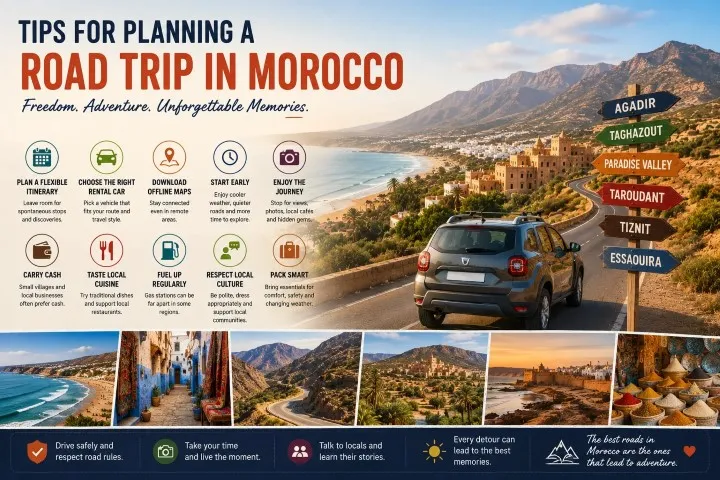
Plan a Flexible Itinerary
It’s tempting to schedule every hour of your holiday, but Morocco is a country that rewards spontaneity.
Leave room in your itinerary for unexpected discoveries.
You might come across:
- A local market full of handmade crafts.
- A hidden beach with no crowds.
- A roadside café serving delicious tagine.
- A scenic mountain viewpoint.
- A traditional Berber village not listed in your guidebook.
Some of the best travel memories are completely unplanned.
Choose the Right Rental Car
Your choice of vehicle should match your travel plans.
For example:
Economy Car
Perfect for city visits, coastal drives, and couples traveling light.
Family Car
Ideal for travelers with children or extra luggage.
SUV
A good option if you plan to explore mountain regions or spend long hours on the road.
Think about comfort as much as price, especially if you’ll be driving every day.
Book Your Rental Car in Advance
If you’re traveling during:
- Summer holidays
- Christmas
- School vacations
- Public holidays
it’s wise to reserve your rental car before arriving in Morocco.
Booking early usually means:
- Better prices.
- More vehicle choices.
- Greater availability of automatic cars.
- Less waiting after your flight.
It also allows you to begin your journey as soon as you land.
Don’t Try to See Everything
Morocco is much larger than many travelers expect.
Trying to visit too many places in a short time often leads to long driving days and less time to enjoy each destination.
Instead, focus on one region.
For example, a southern Morocco itinerary could include:
- Agadir
- Taghazout
- Paradise Valley
- Taroudant
- Tafraoute
- Tiznit
- Essaouira
This allows you to enjoy each stop without feeling rushed.
Download Offline Maps
Mobile coverage is generally good in cities and along major roads, but it can become less reliable in remote mountain areas.
Downloading offline maps before leaving your accommodation can save time and reduce stress.
They’ll continue working even if your mobile signal disappears.
Start Driving Early
Morocco’s landscapes are especially beautiful during the morning.
Starting your journey early has several advantages:
- Cooler temperatures.
- Quieter roads.
- Better lighting for photography.
- More time for sightseeing.
- Greater flexibility throughout the day.
You’ll also avoid driving in unfamiliar rural areas after dark.
Enjoy the Journey
Many travelers focus only on reaching the next destination.
Instead, make the road itself part of your holiday.
Stop whenever you find:
- A beautiful beach.
- A panoramic viewpoint.
- An interesting village.
- A local bakery.
- An artisan workshop.
The journey is often just as rewarding as the destination.
Respect Local Driving Rules
Driving in Morocco is generally straightforward, especially around Agadir and the main tourist routes.
Keep these basic tips in mind:
- Drive on the right-hand side.
- Always wear your seatbelt.
- Respect speed limits.
- Watch for pedestrians in towns and villages.
- Be cautious on mountain roads with sharp bends.
- Keep a safe distance from other vehicles.
Driving calmly makes the experience far more enjoyable.
Carry Cash
Although credit cards are accepted in many hotels and larger restaurants, smaller villages often operate on a cash basis.
Having some Moroccan dirhams allows you to:
- Buy local food.
- Pay for parking.
- Visit small cafés.
- Purchase handmade crafts.
- Support local businesses.
It’s always useful to keep some cash with you during a road trip.
Taste Local Food
One of the joys of driving through Morocco is discovering authentic local cuisine.
Rather than eating only in tourist areas, stop at family-run restaurants where you can enjoy dishes such as:
- Chicken tagine with preserved lemon.
- Beef tagine with vegetables.
- Couscous.
- Grilled sardines.
- Fresh seafood.
- Moroccan salads.
- Homemade pastries.
- Mint tea.
These meals are often among the most memorable parts of the journey.
Pack Smart
You don’t need to overpack, but a few essentials will make your trip more comfortable.
Bring:
- Sunglasses.
- Sunscreen.
- Comfortable walking shoes.
- A reusable water bottle.
- Phone charger.
- Power bank.
- Camera.
- Light jacket for cooler evenings.
Keeping your luggage organized also makes moving between destinations easier.
Fuel Up Before Remote Areas
Fuel stations are common near cities, but they can be less frequent in mountain regions or along quieter roads.
A simple habit is to refill your tank whenever it reaches about half full, especially before exploring remote areas.
It provides extra peace of mind.
Leave Time for Photography
Southern Morocco offers endless opportunities for beautiful photographs.
You’ll find:
- Atlantic sunsets.
- Mountain landscapes.
- Palm-filled valleys.
- Traditional villages.
- Colorful markets.
- Coastal cliffs.
- Historic kasbahs.
Instead of rushing, allow yourself time to stop and enjoy the scenery.
Talk to Local People
One of the easiest ways to experience authentic Morocco is through conversations.
Whether you’re ordering tea, buying fruit at a roadside market, or visiting an artisan workshop, local people often enjoy sharing recommendations and stories.
These interactions can lead you to places you would never have found on your own.
Travel Responsibly
Respecting local communities helps preserve Morocco’s natural and cultural heritage.
Simple ways to travel responsibly include:
- Avoid leaving litter.
- Respect local customs.
- Dress appropriately when visiting villages.
- Support local businesses.
- Ask permission before photographing people.
- Stay on marked paths in natural areas.
Responsible travel creates better experiences for both visitors and local communities.
Sample 7-Day Road Trip
If you’re looking for inspiration, here’s a balanced itinerary:
Day 1: Explore Agadir.
Day 2: Visit Taghazout and Paradise Valley.
Day 3: Drive to Taroudant.
Day 4: Continue to Tafraoute.
Day 5: Explore Tiznit and Sidi Ifni.
Day 6: Visit Legzira Beach before returning toward Agadir.
Day 7: Relax in Agadir or visit Souss-Massa National Park before your departure.
This route combines beaches, mountains, traditional towns, and scenic coastal roads without requiring long daily drives.
Final Thoughts
Planning a road trip in Morocco is about more than choosing destinations—it’s about creating space for discovery. A well-prepared itinerary gives you direction, but the country’s true charm often reveals itself in unexpected moments: a quiet village square, a winding coastal road, a family-run restaurant, or a panoramic viewpoint you hadn’t planned to visit.
By renting a car and traveling at your own pace, you’ll have the freedom to experience Morocco beyond the guidebooks. From the Atlantic coast around Agadir to the mountain landscapes of the Anti-Atlas and the historic streets of southern towns, every road offers a new perspective and a new story.
Take your time, stay curious, and don’t be afraid to follow the road less traveled. In Morocco, those unexpected detours often become the memories you’ll treasure long after your journey has ended. If you search for some car to hire in agadir, we recommand you to look checck our agency :
Company profile : Illi rent cars
Company profile
Company name : Illi rent cars
Address :
- Nom de la rue :FH 500, Av. Hassan Bounaamani
- Ville : Agadir
- Code postale: 80000
- Pays : Morocco
Phone :+212772871388
Email :contact@locationdevoituresagadir.com