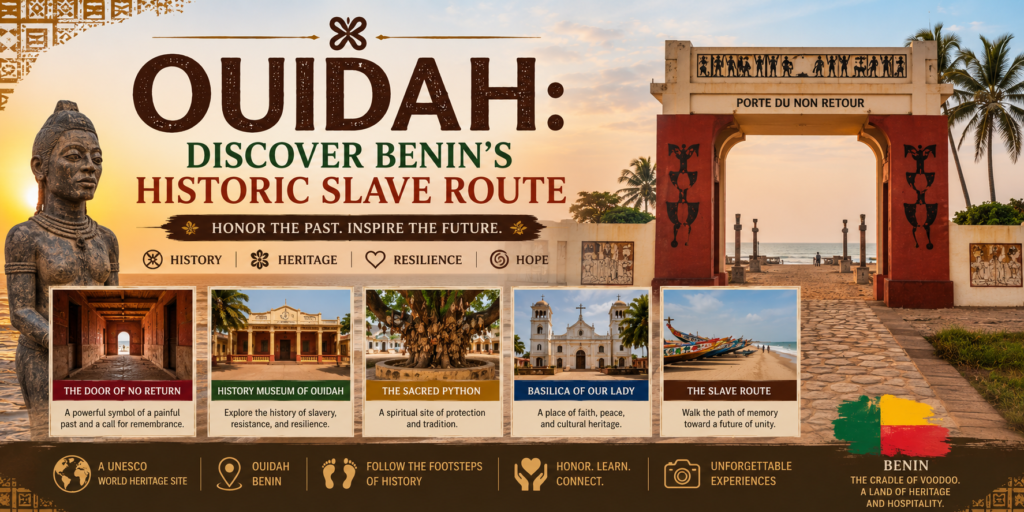
If you are looking for a travel destination in West Africa that blends deep historical significance, rich spiritual traditions, and beautiful coastal landscapes, look no further than Ouidah. Located in the southern part of Benin, this small coastal town holds a massive place in world history.
Ouidah is famously known as one of the most active ports during the transatlantic slave trade. Today, it serves as a powerful place of memory, healing, and cultural discovery for travelers from all over the globe—especially those in the African diaspora searching for their ancestral roots.
In this guide, we will take a deep, respectful walk down the historic Slave Route of Ouidah, explore its connection to the Vodun (Voodoo) religion, and answer the most common questions travelers ask before visiting.
What is the Ouidah Slave Route?
The Ouidah Slave Route (locally known as La Route de l’Esclave) is a 4-kilometer (2.5-mile) dirt path that stretches from the historic center of Ouidah down to the Atlantic Ocean.
Between the 17th and 19th centuries, over one million enslaved African men, women, and children were forced to walk this exact path. Chained together and stripped of their freedom, this was their final walk on African soil before being loaded onto European ships bound for the Americas, Brazil, and the Caribbean.
Today, the route is a symbolic memorial path lined with statues, monuments, and historical markers. Walking this trail is an emotional but essential experience for anyone wanting to understand the history of the transatlantic slave trade.
What will you see along the Ouidah Slave Route walk?
The walk takes you through six major stations, each representing a painful stage in the journey of the captives. It is highly recommended to hire a local guide who can explain the history of each stop.
1. Plaza Chacha (The Slave Market)
Your journey begins in the heart of Ouidah at Chacha Square. This was the bustling, chaotic marketplace where human beings were auctioned off like commodities. European traders bartered with local rulers, exchanging goods like mirrors, alcohol, and gunpowder for human lives.
2. The Tree of Forgetting (L’Arbre de l’Oubli)
Just a short walk from the plaza once stood the Tree of Forgetting (now marked by a monument). Captives were forced to walk around this tree—nine times for men, seven times for women. The ritual was meant to erase their memories, connections to their homeland, and their cultural identity so they would not rebel during the voyage.
3. The Zomaï Huts
The word Zomaï translates to “where light does not enter.” Captives were crammed into dark, windowless huts for weeks or even months while waiting for the ships to arrive. The extreme darkness and lack of space were designed to test their survival and get them accustomed to the brutal conditions they would face in the cargo holds of slave ships. Those who did not survive were buried in nearby mass graves.
4. The Tree of Return (L’Arbre du Retour)
For those who survived the dark huts, they visited the Tree of Return. Captives walked around this tree three times. The ritual was a spiritual promise: even if their bodies left Africa and died in a foreign land, their souls would eventually return to their ancestral home.
5. The Memorial of Remembrance
Before reaching the beach, you will pass monuments dedicated to the millions of souls lost. These modern sculptures and murals pay tribute to the resilience of the African spirit and serve as a warning to the world to never let such atrocities happen again.
6. The Door of No Return (La Porte du Non-Retour)
The path ends on the sandy shores of the Atlantic Ocean, where the majestic Door of No Return stands. This concrete memorial arch, adorned with bas-reliefs of chained captives, marks the exact boundary where millions left Africa forever. Standing under the arch, looking out at the crashing waves, is a deeply moving experience that stays with you long after you leave.
Why is Ouidah considered the spiritual home of Vodun?
You cannot understand Ouidah’s history without understanding its spirituality. Ouidah is the global birthplace and spiritual capital of Vodun (often misspelled as Voodoo in the West).
Far from the dark, negative stereotypes popularized by Hollywood, Vodun is a peaceful, nature-based religion centered around ancestors, spirits, and respect for the earth. During the slave trade, captives carried these spiritual beliefs across the Atlantic, where they evolved into religions like Candomblé in Brazil, Santería in Cuba, and Voodoo in Haiti.
While in Ouidah, make sure to visit these unique spiritual sites:
The Temple of Pythons: Located right across from the historic Basilica, this sacred temple houses dozens of live royal pythons. In Vodun, pythons are sacred symbols of protection, peace, and fertility. Visitors are allowed to enter, learn about the rituals, and even have a python placed gently around their neck for a photo.
The Sacred Forest of Kpassè: This ancient forest is dedicated to the founder of Ouidah, King Kpassè, who is said to have transformed into a tree to escape his enemies. The forest is dotted with beautiful, expressive statues of Vodun deities (or fetishes).
The annual Vodun Festival: If you visit Benin on January 10th, you will witness the National Vodun Day. Thousands of practitioners, traditional chiefs, and tourists gather on the beaches of Ouidah for colorful dances, drumming, animal sacrifices, and spiritual blessings.
Is Ouidah, Benin safe to visit for tourists?
Yes, Ouidah is generally very safe for international tourists. Benin is widely regarded as one of the most politically stable and peaceful countries in West Africa.
While the northern border regions of Benin (near Burkina Faso and Niger) have safety warnings due to regional security issues, the southern coastal region—including Cotonou, Ouidah, and Porto-Novo—remains calm, safe, and highly welcoming to foreigners. All you need is a valid passport and a approved Benin 90-Day Multiple-Entry Visa to start exploring.
Basic Safety Tips for Your Visit:
Respect Sacred Spaces: Always ask for permission before taking photos of people, temples, or religious ceremonies.
Hire a Local Guide: Having a local guide not only provides deep historical context but also ensures you navigate cultural norms smoothly.
Stay Hydrated: The coastal heat and humidity can be intense. Always carry bottled water with you during the walking tour.
How many days do you need to explore Ouidah?
While some travelers visit Ouidah as a day trip from the nearby city of Cotonou (about a 45-minute drive), we highly recommend spending at least two full days in the town.
Day 1: Dedicate this day to walking the historic Slave Route, visiting the Ouidah Museum of History (located inside a restored 18th-century Portuguese fort), and standing at the Door of No Return.
Day 2: Spend this day learning about local spiritual culture at the Python Temple and the Sacred Forest, visiting the contemporary art galleries at the Zinsou Foundation, and relaxing on Ouidah’s quiet beaches.
Ready to Explore Benin? Let Us Help with Your Travel Visa!
Uncovering the profound history and spiritual energy of Ouidah is a bucket-list experience. But before you can walk the sands of the Door of No Return, you will need to secure your entry visa for Benin.
Let us handle the paperwork so you can focus on planning an unforgettable trip.
Why Choose Us?
Reliable Travel Visa Services: Our global approach has assisted numerous travelers in successfully obtaining their Visa to Benin.
Round-the-Clock Assistance: Reach out to us 24/7, and our expert team will respond to your queries within 72 hours.
Experienced Visa Consultants: Receive professional, expert guidance to ensure your visa application is accepted without delays.
Efficient Visa Application Process: Skip the long embassy lines. Apply for your Benin Visa in just a few minutes using our simplified online form.
Start your West African journey today. Apply for your Benin 90-Day Multiple-Entry Visa here!