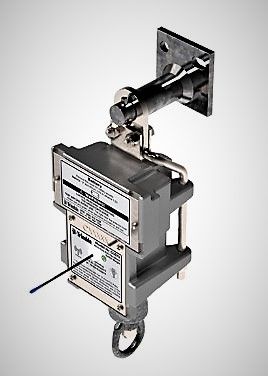
When you are monitoring a crane boom, mast, or other large structure, angle accuracy is not a small detail. Even a small change in angle can affect how you understand the position of the equipment. This is where the LSI Trimble GS010 Wireless Angle Sensor becomes useful.
But how accurate is it in real working conditions? The answer starts with its design. The sensor is made to provide accurate angle readings while also making setup easier than some traditional angle sensors.
What Does the GS010 Measure?
The GS010-01 is a wireless angle sensor made for several angle monitoring needs. It can monitor:
- Boom angle
- List and trim
- Out-of-level conditions
- Luffing job angle
- Live mast angle
- Barge list angle
- Other custom angle applications
This makes it more than a simple boom-angle sensor. Depending on the job, it can help operators keep track of the position of their equipment.
Temperature Compensation Helps Maintain Accuracy
One feature that stands out is temperature compensation.
Why does this matter? Equipment often works in changing temperatures. A sensor needs to keep giving reliable readings even when the temperature around it changes.
The GS010-01 uses temperature compensation to support high accuracy. This can be useful for equipment that works outdoors, where temperatures may change during the day.
The Sensor Has No Moving Parts
Another important part of the GS010-01 design is what it does not have.
It has no moving parts and does not use liquid. This gives the sensor a simple solid-state design for measuring the angle of a structure.
For users, this can make the sensor easier to use and maintain. There is no liquid inside that needs time to settle, and there are no mechanical parts moving as the equipment changes angle.
Self-Leveling Makes Setup Easier
Accuracy is not only about the sensor itself. Installation also matters.
The GS010-01 is self-leveling by design. Its setup process is simple. With the tapped mounting blocks in place, you can put the boom or structure at zero degrees and adjust the sensor until the green light flashes.
The green light shows that the inclinometer is level.
Once it is level, you tighten the sensor into place. There is no need to move the boom or structure to a high angle just to complete a span calibration.
This simple feature can make a real difference during installation. Less setup work means less time spent getting the equipment ready for operation.
What Is the Measuring Range?
The standard inclinometer has a span of -90° to +130°. The list and trim sensor has a span of -45° to +45°. A 360° version is also available.
The right range depends on what you need to monitor. For example, boom-angle monitoring and list-and-trim monitoring may need different measurement ranges.
The sensor also has a typical wireless range of up to 4,300 feet (1,300 meters). This gives it useful reach on large worksites where the sensor and display may be far apart.
How Does It Connect?
The GS010-01 can be installed with GS550, GS553, and GS820 displays, or with a Wire Gateway Router.
This wireless setup can make installation easier because you do not need a long physical cable between the sensor and display.
So, How Accurate Is It?
The GS010-01 is designed for accurate angle monitoring. Its temperature compensation, solid-state design, and self-leveling setup all support reliable readings.
However, it is important not to treat the sensor’s design accuracy as one fixed accuracy percentage for every job. Actual results can depend on the application, installation, measurement range, and working conditions.
The main point is simple: the LSI Trimble GS010 Wireless Angle Sensor combines angle monitoring with features that help make accurate setup easier and more practical.
Conclusion:
If you need a wireless sensor for monitoring boom angle, list, trim, or other angle measurements, the GS010-01 offers a useful combination of measurement range, temperature compensation, wireless communication, and easy installation. For applications that also need load monitoring, the LSI Trimble GS035-CSA Wireless Class 1 Division1 Load Sensor may also be useful.